
NEWS: First development proposal we can recall for G&B was before we started this website by same developer mentioned here: https://westportnow.com/index.php?/v3/comments/pz_denies_hiawatha_lane_development_suit_expected/
NYC art discussion: https://aspetuck.news/lead-news/discussion-of-redding-wire-mill-in-new-york-106707
As part of the wire mill project various transportation improvements
were put in the grant pipeline. That included some bridge work: https://www.thewestonforum.com/85495/two-projects-for-route-7-in-branchville-move-forward/
Not good news: http://www.thewestonforum.com/78333/town-of-redding-wire-mill-site-remains-a-legal-quagmire/
FORUM (April 25, 2017): http://www.thewestonforum.com/77578/first-selectman-to-host-meeting-on-gilbert-bennett/
How about this earlier report: http://www.thereddingpilot.com/2014/07/24/architecture-environmental-impacts-theme-atelier/
---------
"About Town" Public Access TV program, on October 6, 2005, was a tour of
the Gilbert & Bennett Factory building with the developer.
The Gilbert & Bennett Wire Mill part of Georgetown history
(Georgetown is made up of parts of Redding, Wilton, Ridgefield and Weston.) "About Town" television interview with developer of wire mill property not online.

T H E G I L B E R T
& B E N N E T T S I T E


S U S T A I N A B L E D E V E L O P M E N T ?
A new residential village next to
the pond...with
the removal of buildings not suitable for renovation, the former
Gilbert & Bennett wire mill site is considerably more open. Now
visible to visitors is the waterfall, which is expected to be a focal
point. A lesson in what development looks like when
there is water and sewer service available! Upper section site
plan (left) above...click
here for a 2006
report in the Redding PILOT.
If effectively nothing ever took
place in a special taxing district I"STD") designed for a specific
planned development should the STD be taxed at planned use rate or
existing use rate?
Judge: Redding has right to collect unpaid taxes from Wire Mill developers
FORUM
By Christopher Burns on September 15, 2016
What is a Special Taxing District? https://en.wikipedia.org/wiki/Special_district_(United_States)
ABOUT TOWN asks: Does this ruling in the end work against any
development of the property? If the Town can override the Special
Taxing District, what makes the SPD "Special?" And what developer
would want to get into this situation - fronting money, committing to
following funding source rules if they were to receive the grants
already made but not used, and then be tied up by the Town of
Redding? Just a thought...
Story in full: http://www.thewestonforum.com/68932/judge-redding-has-right-to-collect-unpaid-taxes-from-wire-mill-developers/
FROM THE FORUM: http://www.thewestonforum.com/51527/town-of-redding-foreclosing-on-gilbert-bennett-wire-mill/

Transit Oriented Development prize-winning project turning wire mill into village founders...
Redding files foreclosure action against old wire mill owners
By Katrina Koerting, Danbury News-
Updated 4:52 pm, Wednesday, July 15, 2015
REDDING — The town recently filed to foreclose against Georgetown Land
Development Co., which owes millions of dollars in unpaid taxes
connected to the long-delayed redevelopment of the Gilbert and Bennett
wire mill.
If the foreclosure isn’t resolved, the town could become the owners of the 55-acre property.
“It’s potentially a very long process,” First Selectwoman Julia
Pemberton said. “It’s important to note there are many things that could
happen before the town takes it over.”
The foreclosure action, which was filed in state Superior Court in
Danbury, lists 14 defendants including Georgetown Land Development Co.,
JP Industrial Park LLC and the Georgetown Special Taxing District. The
taxing district is a local authority created in 2005 that allowed the
developers to issue government-backed bonds...
Please search the Danbury News-Times archives for the remainder of this story.
Redding moves to foreclose on Gilbert and Bennett redevelopment
Dirk Perrefort, Danbury News-Times
Published 1:00 am, Sunday, May 10, 2015
REDDING -- Local taxpayers may be on the hook for millions of
dollars in back taxes and bad debt accrued by the Georgetown Land
Development Co. for the long-defunct redevelopment of the Gilbert and
Bennett wire mill.
The redevelopment effort surrounding the mill was once heralded nationally as a model of transit-oriented development...
The project stalled, he said, because all of the necessary permits for
the project weren't secured before the financial meltdown of 2008. The
significant amount of debt encumbering the property, he said, has made
any effort to move forward with the project almost impossible.
Both Lynch and Scott Taylor, the undersecretary of intergovernmental
policy for the state's Office of Policy and Management, said there have
been discussions with the holders of the general obligation bonds to
take over the project. The bondholders, local officials said, are
Oppenheimer, William Harris Investors and Invesco.
"At least one of the bondholders has been in discussions about a potential takeover of the property," Taylor said.
He added that OPM closely watches taxing districts that have
government-backed general- obligation bonds. Allowing such bonds to
default, he said, would set a bad precedent in the state.
"The state is actively monitoring the situation to make sure that
everyone who issues debt in this fashion lives up to their obligation,"
he said.
Officials with the taxing district sent a letter to state officials in
March, a copy of which was recently obtained by The News-Times, that
states, "it is believed that the bondholders' intent is to acquire title
rights to the property and then commence development in accordance with
the approved master plan."
The letter, signed by Lynch, also states that "to this objective, the
bond holders have met with other lien holders, including the town of
Redding. It is our understanding that agreements have been reached
between the bond holders and other lien holders, excluding the town of
Redding..." Story in full: http://www.newstimes.com/business/article/Redding-moves-to-foreclose-on-Gilbert-and-Bennett-6251955.php
NOVEMBER 2014: Public review of Gilbert & Bennett story with new First Selectman of Redding: http://www.thewestonforum.com/23382/update-on-gb-project-in-georgetown/
Town prepares foreclosure on G&B property
Redding PILOT
By Kaitlin Bradshaw on June 5, 2014
The town is prepared to go forward with foreclosure proceedings on the
former Gilbert & Bennett wiremill site unless Georgetown Land
Development Company LLC (GLDC) and its developer can reach an agreement
with the state to secure a $5.6-million grant for infrastructure work.
“After rampant delays and a threatened loss of state funding, the town
of Redding has decided that it cannot wait any longer for progress on
the former Gilbert & Bennett development site,” said First Selectman
Julia Pemberton in a prepared statement on June 3...
Please search the Redding PILOT archives for the remainder of this story.

Photo at left by Thomas Nash
Former G&B sale: The deal is off
Weston FORUM
Written by Susan Wolf, the much beloved late editor of the Redding PILOT
Thursday, 15 July 2010 00:00
Georgetown Land Development Company announced last week it no longer
has a contract to sell its Georgetown development site to Georgetown
Green, LLC.
...Tax liens
Redding sold tax liens on the former mill property to Georgetown Land
Development Company in June 2002 and, by 2004, a Master Plan special
permit for the project was approved by the Zoning Commission. The
Master Plan details the redevelopment of the site.
Plans call for a mixed use of residential, commercial and retail
development in a pedestrian-friendly, transit-oriented village.
Included in the plan is 40 units of affordable housing for seniors, a
new train station, and a community theater.
The state and local approvals are now in place for the project. Over
the last few years, structurally unsound buildings have been demolished
and the Norwalk River, which had been covered by buildings on the site,
has been daylighted.
A brownfield, the environmental remediation plan for the site, has been
approved. A Georgetown Special Taxing District is in place specifically
for the site and the Georgetown sewer plant has been expanded to
accommodate the development planned for the site. GLDC said it would
pay for the cost of the expansion and its share of the bill through
monthly delta payments.
“Presently, the taxing district does not have the funding to meet its
financial obligations to the Water Polution Control Commission. As soon
as that funding is available, arrangements will be made for prompt
payment,” said Mr. Lynch...
At Gilbert & Bennett site:
Projects taking shape, but awaiting state action
Weston FORUM
Written by Susan Wolf
Thursday, 06 August 2009 00:00
It might look quiet at the former Gilbert & Bennett wire mill site,
but that doesn’t mean things aren’t happening...
TIF
Mr. Soler also said when his company sells to third parties, it
increases the value of these parcels for local tax purposes, creating
new tax revenue for the town. The increase in tax revenue is the basis
for Tax Increment Financing (TIF) should the company decide to pursue
it, said Mr. Soler.
Under the TIF, the Connecticut Development Authority would reimburse
GLDC for infrastructure work, estimated to cost $3.5 million. The town
would negotiate an agreement with the state and GLDC to allow it to
help pay back that loan through portions of the anticipated increase in
tax revenues on the commercial properties only, as the project moves
forward.
As for the train platform, Mr. Soler said the state has made a
commitment of $3.5 million to fund it. However, State Bonding Commission approval is needed, and the
commission won’t meet until the state budget is balanced. The money for
the railroad crossing work is also awaiting bond commission approval...
Please search the FORUM archives for the remainder of this story...we do not always mention for FORUM articles.
In the Region | Connecticut
7 Years In, Renewal Plan Languishes
NYTIMES
By LISA PREVOST
June 21, 2009
REDDING
AFTER seven years’ work on a redevelopment plan that attracted
enthusiastic support from residents of this affluent town, the
developer, Stephen Soler, is so depleted by state bureaucratic delays
that he is ready to walk away.
“We have been looking for a buyer to take the whole thing — let’s leave
it at that,” said Mr. Soler, the principal of the Georgetown Land
Development Company. “This has been an extremely, extremely expensive
exercise.”
Mr. Soler’s $300 million plan to build a transit-oriented village on
the site of the Gilbert & Bennett wire mill had promised to fill
the hole left in Redding’s commercial tax base after the factory shut
down in 1989. In a corner of Redding known as Georgetown, the factory
was the only industrial development in a town characterized by two-acre
zoning and a great deal of open space.
A master plan approved for the 55-acre site in 2004 allowed for more
than 400 housing units, as well as more shops, restaurants and offices,
a performing arts center and a new train station. The focus was on
preserving the mill’s rich historical legacy within a densely developed
village environment that minimized the need for cars and maximized
energy efficiency.
Although Mr. Soler has proceeded with some demolition, environmental
cleanup and a new wastewater treatment facility, most of his vision
exists only on paper. The fault lies primarily with the state, he says,
for delaying him right into a recession.
With the credit markets so tight, “the biggest problem now is the
ability to get financing to do the infrastructure,” he said.
The delays also figured in the loss of a $50 million contract with TCR
Northeast Land Acquisition for the housing development rights to the
project. TCR, an affiliate of Trammell Crow Residential of Dallas, had
agreed to buy six parcels intended for town houses and lofts, once all
necessary permits and approvals were in place. It terminated that
agreement in July.
Joseph S. Torg Jr., a senior managing director for TCR’s northeast
office, ascribed the decision to several factors, including the
near-collapse last year of A.I.G., the international insurance company,
which had been TCR’s equity source in the deal...
Please search the NYTIMES archives for the remainder of this story.
Congressional OK sought for expansion
of historic site
Norwalk HOUR
September 12, 2007
The Weir Farm National Historic Site is seeking congressional authority
to expand its territory beyond Wilton and Ridgefield.
At a U.S. Senate subcommittee hearing Tuesday, National Park Service
deputy director Daniel N. Wenk testified that the Department of the
Interior will support legislation that would help the historic site to
acquire new facilities at no extra cost.
"We believe that we can exchange land, save money," Wenk said during
the hearing of the Energy and Natural Resources Subcommittee on
National Parks...
Please search the HOUR archives for the remainder of this story.
Former Gilbert & Bennett site: Owners seek environmental designation
by SUSAN WOLF, Hersam Acorn Newspapers
May 26, 2007
Just as the redevelopment of the former Gilbert & Bennett site in
Georgetown is moving toward infrastructure work, its owners are hoping
to get an environmental LEED development designation for their
redevelopment project.
Stephen Soler, Georgetown Land Development Company president, the
redeveloper of the former manufacturing site, said his project is among
360 applications for a LEED (Leadership in Energy and Environmental
Design) pilot program. If approved, he said, his project would be
designated a Gold LEED development, and the designation would apply to
the entire development.
The LEED for Neighborhood Development Rating System integrates the
principles of smart growth, urbanism, and green building into the first
national standard for neighborhood design, according to the U.S. Green
Building Council’s Web site.
“LEED certification provides independent, third-party verification that
a development’s location and design meet accepted high standards for
environmentally responsible, sustainable, development,” the council
says.
The designation “is based on the way a project is planned and laid out
in the community,” Mr. Soler said. Among the pluses for the Gilbert
& Bennett site redevelopment, he said, are the daylighting of the
Norwalk River, which runs through the site, a walkable community, the
creation of more open space than existed, the recycling of material on
the site, brownfield remediation, and the planned new railroad station.
Mr. Soler is optimistic about his development getting the designation
later this month...The Georgetown Special Taxing District, which only applies to the
redevelopment site, will serve as the regulating body to ensure
adherence to the design code.
From the
BUSINESS section of Stamford ADVOCATE:
Greenwich developer wins funds for project
Stamford
ADVOCATE
By Richard Lee, Assistant Business Editor
Published February 18 2006
The U.S. Treasury Department has
approved $72 million in special tax-exempt bonds for the reconstruction
of Greenwich developer Stephen Soler's abandoned mill in Redding.
The Treasury Department
designated the Georgetown Special Taxing District as a "qualified green
building and sustainable design project."
The tax-exempt bonds are part of a
$300 million financing package for Soler's conversion of the former
Gilbert & Bennett wire mill into a village-like complex with 416
residences, including 32 single-family homes. Also planned are offices,
stores and restaurants...
Please search the ADVOCATE archives for the remainder of this story.
Georgetown Special Taxing District: 'Green Bond' designation one of
only four in country
Redding
PILOT
By SUSAN WOLF
Feb
2, 2006
The Georgetown Special Taxing
District has received a special
tax-exempt bond designation from the U.S. Treasury. This will allow the
district to issue more than $72 million in qualified “green” building
and sustainable design project bonds.
The taxing district will oversee the redevelopment of the former
Gilbert & Bennett wire mill site in Georgetown, which is owned by
Georgetown Land Development Company (GLDC). Special state legislation
was passed last year allowing for the creation of the district, which
was established last September. The company wants to use this
special tax district as a financial mechanism for the redevelopment of
its property, a brownfield site. GLDC is working with state and federal
environmental agencies to clean up the former factory site...
$72M grant for
'green' mill redevelopment
By ANNA GUSTAFSON, Hour Staff Writer
January 27, 2006
WILTON — Georgetown's Gilbert & Bennett Wire Mill redevelopment
project is well on its way to providing at least 1,500 new jobs just
over the Wilton border with a $72 million federal government handout.
The special tax-exempt bond designation from the U.S. Treasury
Department allows the Georgetown Special Taxing District, which is
overseeing the project, to issue more than $72 million in qualified
green building and sustainable design project bonds...
Please search the HOUR archives for the remainder of this story.
Breaking News...
At Gilbert & Bennett site: Traffic plan is approved
Stage is set for development
by SUSAN WOLF, pilot@acorn-online.com
Sep 28, 2006
A major hurdle has been crossed for the redevelopment of the former
Gilbert & Bennett wire mill site in Georgetown.
State Traffic Commission approval is now in place; once the
requirements are met, the developer can get his traffic generator
certificate from the commission and begin “to pull building permits in
town.” That means, said Stephen Soler, president of the Georgetown Land
Development Company (GLDC), the redeveloper, that his company may sell
or finance property. “We need this to develop.”
GLDC owns the 55-acre wire mill site off Route 107. The residential
component of the plan calls for a total of 416 units of housing, with
249 loft units, 69 townhouses, 32 single-family homes, 15 affordable
units for artists, 11 apartments over retail buildings, and 40 units of
subsidized housing for senior citizens. A community theater and a
satellite for the Wilton Family Y are included in the plans, as well as
a new railroad station and retail and commercial businesses. The end
result will be a pedestrian-friendly village at the site.
On Aug. 12, the State Traffic Commission approved the company’s traffic
proposals with some conditions. The company subsequently appealed three
of them, said Mr. Soler on Monday. The traffic commission wanted
the
company to post a $10.4 million bond to cover the work it proposed.
“Because we are not road contractors, this meant we would have to put
$10.4 million in a bank account,” said Mr. Soler.
“We contested this,” he added, “because not all of the improvements
will be done by Georgetown Land Development Company.”
The traffic commission wanted the bonding to cover the new train
station and the parking garage that will accompany it, the relocated
rail crossing on North Main Street and other off-site improvements,
including work at several intersections. North Main Street runs through
the land the company owns. A portion is being relocated, along with the
railroad crossing, to accommodate the project...
REDDING APPLICATIONS:
Planners open hearing on
G&B plan
Redding PILOT
Feb 2, 2006
The Planning Commission opened its public hearing on Georgetown Land
Development Company’s application for the proposed subdivision of 45
acres into 106 lots last Tuesday, Jan. 24.
Georgetown Land Development Company (GLDC) is the redeveloper of the
former Gilbert & Bennett wire mill site off Route 107. The company
is a proposing a pedestrian-friendly village for the area with mixed
uses of housing, retail, commercial and light industrial. A
community theater, health club, and new train station are among the
items in its proposal.
Commission Chairman Diane Taylor said the commission has received all
maps and documents, along with the qualifications of the consultants,
and GLDC’s Design Code and zoning information. Ms. Taylor said because
of the unusual scope of the application, in that it exceeds the normal
application size and context, the planners would wait to review the
materials at its Jan. 31 meeting, giving the town’s consultants time to
review any additional materials in time for the continuance of the
public hearing on Feb. 14.
John Hayes, town planning consultant, said it is a very complex
application due to the large number of lots and the revised street
configurations, which are involved. He is in the process of reviewing
it...
Gilbert
& Bennett history page...there
will be Public Hearings in Redding before three (3) separate Redding
Commissions:
- First is the Redding Planning
Commission on Tuesday, January 24, 2006..."a subdivision of 45
acres into 106 lots;"
- Redding
Conservation Commission has not notified the Town Clerk's Office re:
date and time, but we expect it is next...or concurrent with the
Planning Commission;
- "Public Hearing of the Redding Zoning
Commission on February
8, 2006 (Wednesday) at 7:30pm in the Hearing Room at the Redding Town
Hall" takes place. Purpose of the hearing will be to
review an application for
a site
plan approval from Georgetown Land Development for the
portion
of the property located north of Redding Road (Rte. 107). It is
the understanding of Redding ZEO that a set of plans has been forwarded
to the "appropriate planning commission." A copy of the
application form is below:

A
page from the summary of the August 2005 traffic report...to be
discussed February 8, 2006: the bottom line=less traffic than
when Gilbert & Bennett factory was in business.

In
the spirit of light being good and dark being bad, which area do you
think will be developed for occupancy first? (Just our guess!)

PREVIOUSLY...
On March 24, 2004, at 7:30pm in the
Hearing Room of the Redding Town Hall there will be a Public
Hearing...to
which residents of Weston are invited. The purpose of the hearing
is to review proposed amendments to the Redding Zoning Regulations with
respect to their "Special Development District" in the historic
neighborhood
of Georgetown - specifically, the former Gilbert & Bennett mill
site.
If you have any questions, you are invited to contact Tom Gormley,
Zoning
Enforcement and Wetlands Officer: (203) 938-8517.
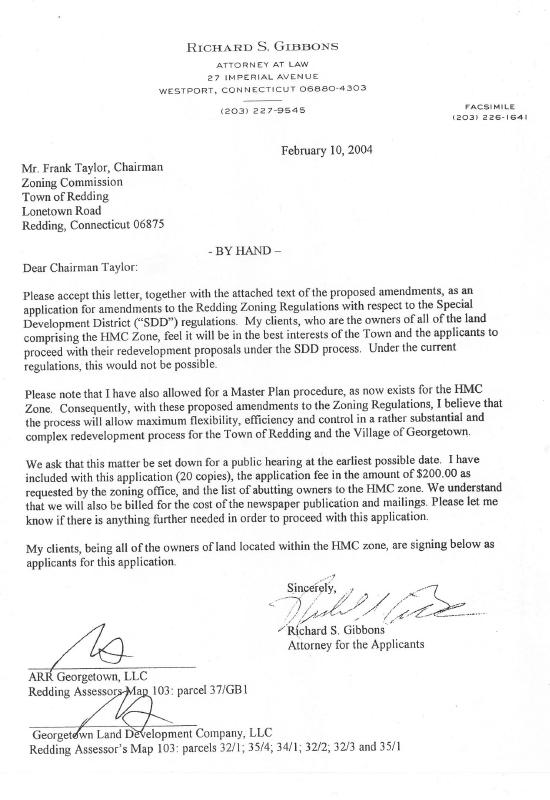
Below
is a letter from Attorney Richard
Gibbons, long-time representative for the company, and a thoughtful
person.


NORWALK HOUR "25 YEARS AGO" - OCTOBER 10, 2013
In those days The Hour had a reporter covering Weston. And its
report, quoted here, gives us the date of the earliest of the proposals
we have experienced for the Gilbert & Bennett factory property.
We were there - 1988 - attending meetings a member of the Weston P&Z to observe potential impacts.
P.S. Redding didn't approve this, although we don't recall why.